
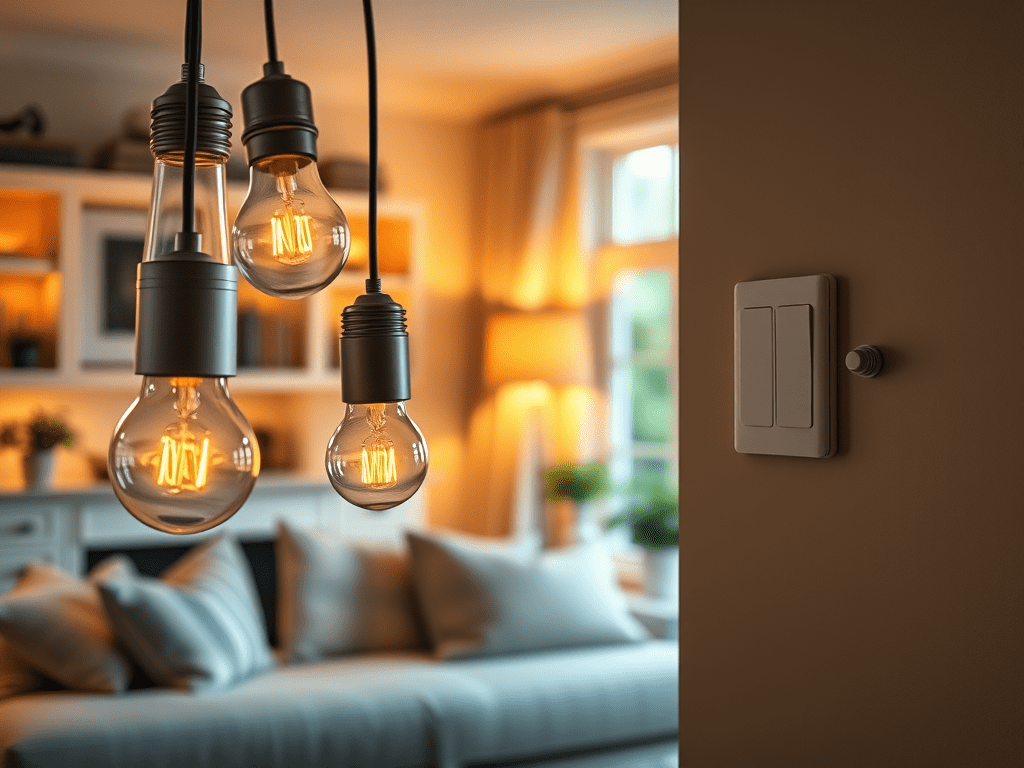
Now that you’ve chosen the very voice your smart home will speak, and perhaps even welcomed a little speaker into your abode, we turn our attention to the immediate, tangible delights. And for this, my dear reader, there is truly no better place to begin than with smart lighting. It was, after all, my own initial foray into this world, driven by the rather insistent demands of my house’s energy bill, that first unveiled the true genius of it all.
Beyond the pleasant surprise of a lighter Hydro bill, smart lighting offers a nuanced control over your home’s ambiance, a truly transformative power. But how does one navigate this luminous path? You’ll find yourself at a gentle fork in the road, considering two main approaches: smart bulbs or smart switches, and whether a bridge is necessary for your chosen path.
Let’s illuminate these choices:
1. The Path of Smart Bulbs:
For many, this is the simplest entry. You simply screw a smart bulb into your existing light fixture, much as you would any traditional bulb. These bulbs, which speak directly to your chosen ecosystem (Alexa or Google/Gemini), can change color, dim, and often offer a vast spectrum of white light, all controlled from your app or voice.
- Why choose them? They are wonderfully easy to install – no wiring required, making them perfect for renters or those hesitant about electrical work. You can begin with just one or two, slowly transforming your space. Brands like LIFX or Kasa offer Wi-Fi bulbs that connect directly to your home network, requiring no extra hub. Philips Hue, a well-regarded system (my favourite to be honest) often requires a bridge, which we’ll discuss next.
- A quiet caution: Your traditional light switch must remain “on” for the smart bulb to receive power and respond to commands. This can sometimes feel counter-intuitive at first.
2. The Path of Smart Switches or Dimmers:
Alternatively, you can replace your existing wall switches with smart versions. These smart switches then control all the lights connected to that particular circuit, effectively making all your regular bulbs “smart” by proxy.
- Why choose them? This approach feels more permanent and traditional; you still interact with a physical switch on the wall. It’s often more cost-effective if you have many bulbs in a single fixture or room, as one smart switch controls them all. Again, brands like Kasa (my second favourite) offer Wi-Fi switches that connect directly, while others, like Lutron Caséta, typically utilize a bridge.
- A quiet consideration: Installing smart switches usually involves a bit of electrical wiring. If you’re comfortable with such tasks, it’s straightforward, but if not, an electrician might be a wise investment.
And What of this “Bridge”?
You may have noticed the mention of a “bridge” or “hub.” Think of this as a quiet intermediary, a dedicated little box that connects certain smart lighting systems to your home’s Wi-Fi network and, by extension, to Alexa or Google/Gemini. Systems like Philips Hue and Lutron Caséta often employ these bridges.
- Why a bridge? These bridges often use different wireless languages (like Zigbee or Clear Connect) that are incredibly reliable and create their own robust network, reducing congestion on your main Wi-Fi. They can also offer advanced features and ensure consistent performance, especially for larger smart home setups.
- The gentle trade-off: It’s another small device to purchase, plug in, and set up, adding a touch more complexity at the very beginning.
My own initial foray into lowering that demanding energy bill involved a mix, but the core was that intuitive on-and-off. Whether you choose the directness of a Wi-Fi bulb, the more integrated feel of a smart switch, or the robust reliability of a bridge-based system, the key is to choose what aligns with your comfort level and the nature of your home. Begin where the problem is most apparent, and you’ll soon discover the quiet genius that smart lighting can bring to your cherished sanctuary.

 Hustle & Harmony
Leave a comment